

Summary video
PTEN deficiency in prostate cancer is often the result of genomic PTEN deletion
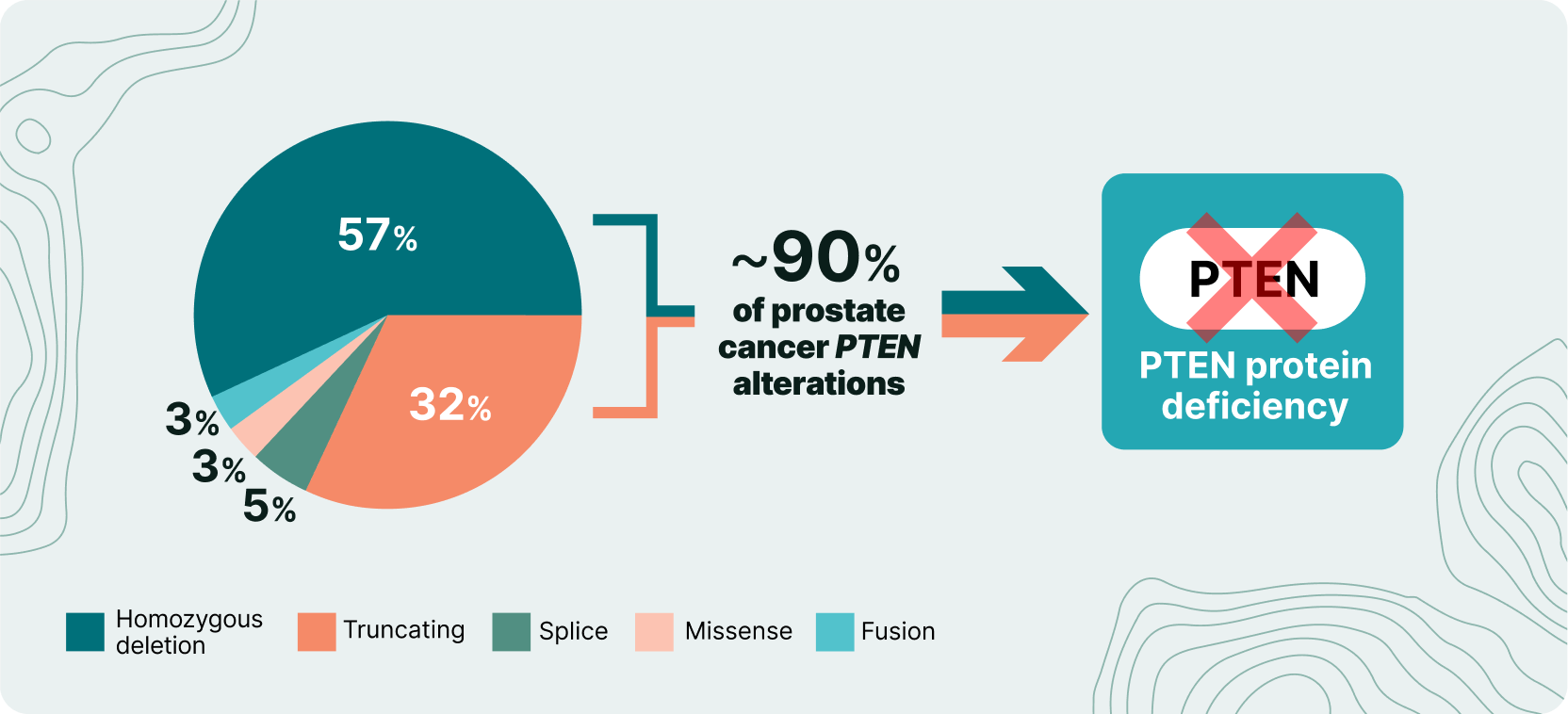
While multiple mechanisms can affect PTEN function, deletions of the PTEN gene are the most common cause of PTEN deficiency in prostate cancer.2,3
- PTEN deletion and other alterations can be detected by genomic analyses like NGS or FISH
- The resulting loss of PTEN protein can be detected by IHC
Genomic aberrations in prostate cancer4
NGS can be used to detect PTEN deficiency, but may miss a proportion of PTEN-deficient prostate tumors
Most PTEN-deficient cases can be identified by incorporating somatic PTEN testing into the standard-of-care NGS testing of metastatic prostate tumors.5–8
- Genomic PTEN testing is available or can be added as part of some routine NGS panels6,7
- Circulating tumor (ct) DNA-based NGS is not appropriate for detecting gene deletions in mHSPC, including PTEN9
As deficiency of the PTEN protein can sometimes occur without PTEN gene deletion or other genetic alterations, relying solely on NGS may overlook a proportion of PTEN-deficient tumors.8,10,11
IHC is the preferred method for detecting PTEN deficiency
By capturing the diverse mechanisms of PTEN gene inactivation, including non-genetic changes that may lead to PTEN protein deficiency, IHC may enhance the identification of PTEN-deficient prostate tumors beyond that of genomic analyses.2,3

Highly sensitive
Cost effective
Low turnaround time
PTEN deficiency, as defined by a loss of PTEN protein in ≥90% of viable malignant cells by IHC, is associated with worse recurrence-free survival compared with PTEN proficiency.12,13
IHC offers a reliable, accessible and rapid method for testing PTEN deficiency in metastatic tumor samples.3,7,11,14
PTEN IHC testing masterclass
Elevate your understanding with this masterclass focused on the practical application of PTEN IHC testing in metastatic prostate cancer.

Introduction to IHC testing
Explore why PTEN deficiency testing matters and how this can be achieved using standard IHC techniques.
View and download (PDF)
Prostate IHC Explorer: Pathology image library
- Explore real pathology images to support scoring accuracy and diagnostic consistency
- Examine real-world staining patterns and tissue characteristics

Key publications
Examine key publications to learn more about the diverse, non-genomic mechanisms that can affect PTEN function, as well as PTEN testing strategies.
Explore key publicationsAre you and your MDT ready to integrate PTEN deficiency testing into clinical practice?
An integrated MDT approach can help overcome challenges to biomarker testing for prostate cancer, including implementation of institutional testing protocols, routine ordering of recommended tests and standardized reporting.15
Look out for our downloadable guide to support productive conversations with your MDT, helping to streamline planning and overcome barriers to implementing PTEN deficiency testing within your clinical setting – coming soon.
knowledge check
ctDNA, circulating tumor deoxyribonucleic acid; FISH, fluorescence in situ hybridization; IHC, immunohistochemistry; MDT, multidisciplinary team; mHSPC, metastatic hormone-sensitive prostate cancer; NGS, next-generation sequencing; PTEN, phosphatase and tensin homolog.
1. Jamaspishvili T, et al. Nat Rev Urol. 2018;15(4):222–234; 2. Turnham DJ, et al. Cells. 2020;9(11):2342; 3. Wise HM, et al. Clin Sci (Lond). 2017;131(3):197–210; 4. Stopsack KH, et al. Clin Cancer Res. 2022;28(2):318–326;
5. Yu EY, et al. J Clin Oncol. 2025;43(6):748–758; 6. Sweeney C, et al. Lancet. 2021;398(10295):131–142; 7. Giunta EF, et al. Cancers (Basel). 2021;13(19):4771; 8. de Bono J, et al. ASCO-GU Cancers Symposium, Virtual, February 11–13, 2021. Abstract 1; 9. Antonarakis ES, et al. ASCO Genitourinary Cancers Symposium, San Francisco, CA, February 13–15, 2025. Abstract 53; 10. de Bono JS, et al. Clin Cancer Res. 2019;25(3):928–936;
11. Pulido R, et al. Cold Spring Harb Perspect Med. 2019;9(12):a036293; 12. Lotan TL, et al. Eur Urol Focus. 2016;2(2):180–188; 13. Lotan TL, et al. Clin Cancer Res. 2011;17:6563–6573; 14. Lotan TL, et al. Mod Pathol. 2016;29:904–914; 15. Plotkin E, et al. J Clin Oncol. 2019;37:49.